
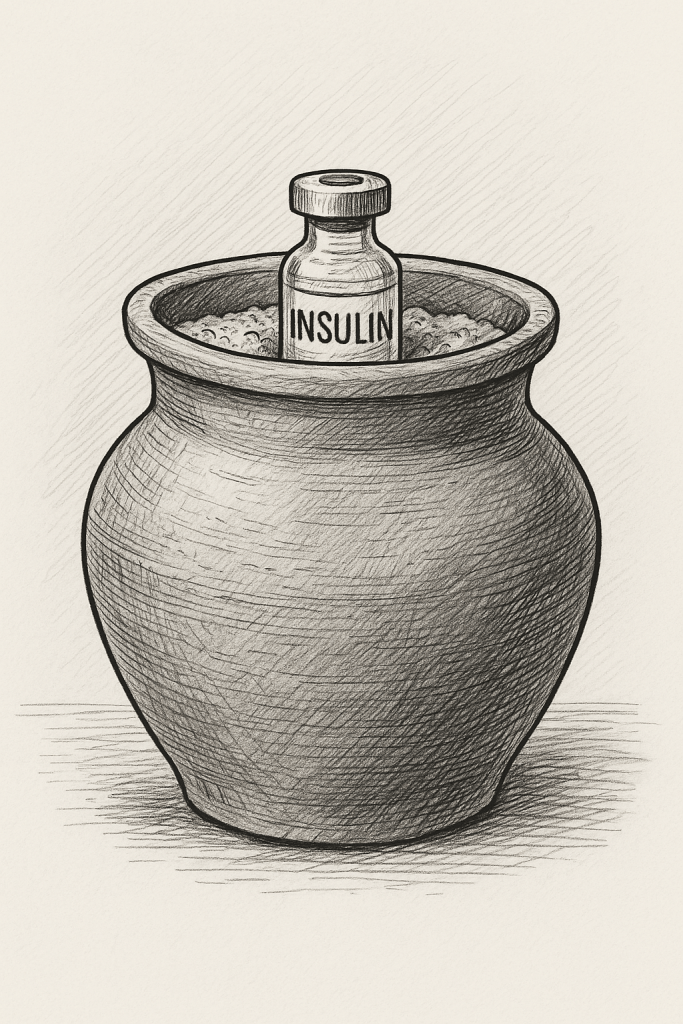
I recently came across something that really stuck with me, a simple, almost ancient technique that’s helping people survive in some of the most difficult conditions on earth. In places where electricity is unreliable or entirely unavailable, people are using clay pot coolers to store life-saving medication like insulin.
It’s a method that doesn’t rely on wires, batteries, or high-tech design. No electricity. No expensive equipment. Just local materials and clever thinking.
The clay pot cooler or Zeer pot, was brought into wider use in the 1990s by Mohammed Bah Abba, a teacher from northern Nigeria. He comes from a long line of pot makers, equipped with both scientific and traditional knowledge.

He saw how families in rural areas were struggling to keep food and medicine safe without power, and came up with this beautifully simple solution. His idea, placing a smaller pot inside a larger one with wet sand in between, and covering it with a damp cloth, uses natural evaporation to lower the temperature. As the water in the sand in the outer pot evaporates, the inner pot is cooled to as low as 4.5 degree C, preventing bacteria from flourishing and keeping foods, vaccines, medication like insulin that require refrigeration safe.
It earned him the Rolex Award for Enterprise in 2001, and since then, this method has been adopted across Africa, the Middle East, and beyond. From his price fund of $75 000 he was able to make the innovation accessible throughout Nigeria. Before his death in 2010, he was able to donate over 7,000 pots to local villages.
It’s a powerful reminder that life-saving innovation doesn’t always come from a lab, sometimes, it starts with local knowledge and a deep understanding of what people truly need.
For people living through conflict, displacement, or poverty, this isn’t just about keeping food or medication cool, it’s about staying alive. When health systems break down or don’t reach far enough, these kinds of grassroots solutions become essential. And this is exactly the kind of thinking we need more of in global health: practical, grounded, and human-centered.
Let’s keep shining a light on these amazing contributions to medical innovations, the ones that don’t make headlines but make a massive difference. Because saving lives doesn’t always mean inventing something new. Sometimes, it’s about reimagining how we use what we already have.
Thanks for stopping by
Amina xxx
🕊️ Mohammed Bah Abba (1964–2010) , an innovator whose deep wisdom and ability to adapt the world around him turned clay and sand into life-saving tools. His simple invention brought ease to everyday life, helping families store food longer and protect vital medicines in the harshest conditions. His legacy continues to cool the world’s warmest places.

 SUGAR HIGH SUGAR LOW - TYPE 1 D LIFE
Thank you for this short inspiring story. It helps us all to think if we can also be as creative as Mohammed Bah ABBA
LikeLiked by 1 person